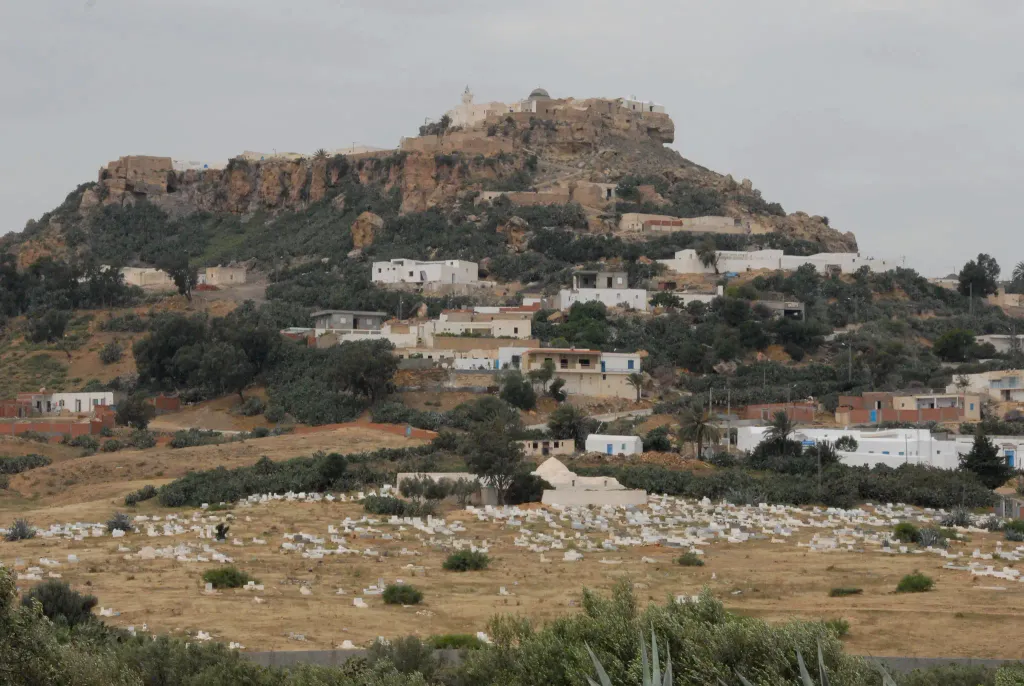
Official Website Twitter Feed Facebook Fan Page U.S. Army Africa Soldiers apply lessons of WWII to current mission By Rick Scavetta, U.S. Army Africa KAIROUAN, Tunisia – Col. Stephen Mariano looked down into a foxhole carved atop a rocky hill top near El Guettar, where in March 1943, troops from U.S. Army II Corps battled German panzers. Nearby, retired Army Col. Len Fullenkamp conjured tales of U.S. Army Rangers under Lt. Col. William Darby marching through darkness along a nearby ridge to surprise sleeping enemy infantrymen with fixed bayonets. Soldiers from the 1st Infantry Division hacked fighting positions from solid rock as enemy tanks rumbled into the valley. U.S. Army artillery units skimmed shells across the desert at approaching German armor. Mariano began to wonder, “Had my grandfather dug one of these foxholes? Was his artillery position somewhere nearby? Did he fire on Germans coming through this gap?” Mariano, 45, of Redlands, Calif., was among several U.S. Army Africa officers who took part in a four-day “staff ride,” – onsite discussions of Tunisia’s World War II battlefields geared toward finding insights into U.S. Army Africa’s present challenge – building cooperative relationships with African land forces to increase security, stability and peace in the region. In late 1942, U.S. forces landed in North Africa with British troops. Their first fights were with Vichy French units, who later joined the Allied cause. Together, they pushed east into Tunisia, where they clashed with German and Italian troops among craggy, cactus-covered hills and washed out wadis. As a U.S. Army Africa’s strategic planner, a look back at the alliance between American, British and French forces offered Mariano a glimpse at an international coalitions’ growing pains and how friction between partners can doom a mission. On a more personal level, the staff ride allowed him to recapture his family’s past. Henry Mariano, Sr., was a sergeant with the 2nd Battalion, 62nd Armored
Author: US Army Africa from Vicenza, Italy, License: Public domain
· Source
Registration is currently only possible with an invite code. Please enter your invite code or use your personal invite link. If you don't have a code, you can request one from us.
 alpha
NOW FEDERATED!
alpha
NOW FEDERATED!